
Case Study: 2022, Potato Trial at Frog Lane Farm, Pickmere
Aim: To compare locally sourced Rock Dust vs chemical fertiliser for the medium-term goal of eliminating the chemical fertilisers from its crop growing procedures.
Background:
Frog Lane Farm, in Cheshire, has been in the Ollier family since 1947 and now being farmed by the 3rd generation, Andrew Ollier. It is a 900-acre, mixed dairy, beef, and arable farm. Growing crops including grass pasture, maize, and potatoes.
Animal manure has always been applied on the land, while chemical fertilizers are also extensively used to increase yields, particularly on the maize and potato crops.
Over the years the soil testing is continually showing more nutrient problems. This shows up especially on where the maize and potatoes are being grown. Even though the crops are grown in a wide rotation.
Andrew Ollier was looking to find more sustainable methods even before the sudden rise in fertiliser costs. He contacted Agrimagined Ltd who have been researching and now can source “tested rock dusts” which are known to remineralize the soil.
An agreement was then reached to conduct a potato trial on his farm with the variety, Maris Piper.
The Trial Results
Procedure: the rock dust was applied at a rate of 2 tonnes /acre at the cultivation time just prior to the potatoes being planted on May 2nd. It was mixed into the topsoil. The same procedure was applied with the farmyard manure (FYM) which was semi decomposed.
Fertiliser was applied at 400 kg/acre and FYM at 20 tonnes/acre.
The foliar feed was applied at the rate of 3 Litres/acre which was applied starting at the rosette growing stage.
Initially the growth was slow due to the very dry weather until some rain arrived towards the end of July.
The nutrient costs applied relating to 2021 pricing for 2022 production:
Fertiliser Spread Cost @ 400 kg/acre = £320/acre
Farmyard Manure Spread Cost = £100/acre
Foliar Product Cost = £31/acre
Rock dust Spread Cost @ 2 tonnes/acre = £160 /acre
The nutrient costs applied relating to 2022 pricing for 2023 production:
The nutrient costs below were adjusted to reflect the price increase during the 2022 growing season:
Fertiliser Spread Cost @ 400 kg/acre = £420/acre
Farmyard Manure Spread Cost = £110/acre
Foliar Product Cost = £36/acre
Rock Dust Spread Cost @ 2 tonnes/acre = £160 /acre
Table 1: Trial Results and Costings
Application | Rock dust, Farmyard Manure and Foliar | Farmyard Manure and Foliar feed | Rock Dust, Foliar and Fertilizer | Fertilizer and Foliar feed |
| Date dug | 10/10/2022 | 10/10/2022 | 10/10/2022 | 10/10/2022 |
| Variety | Maris Piper | Maris Piper | Maris Piper | Maris Piper |
| Size | 45+ | 45+ | 45+ | 45+ |
| Dry Matter (%) | 22.3 | 22.5 | 22.2 | 22.6 |
| Tuber count in whole sample | 52 | 59 | 55 | 59 |
| Weight of whole sample (Kg) | 11.15 | 9.75 | 9.35 | 8.5 |
| Tuber count in 10kg | 47 | 60 | 59 | 71 |
| Estimated tonnes/acre | 22.4 | 21.5 | 20.7 | 18.8 |
| Costings | ||||
| Nutrient Cost per acre 2022 | £291.00 | £131.00 | £511 | £351.00 |
| Cost / Tonne 2022 | £12.99 | £6.09 | £24.69 | £14.56 |
| Nutrient Cost per acre 2023 | £306.00 | £146.00 | £616.00 | £456.00 |
| Cost / Tonne 2023 | £13.66 | £6.79 | £29.76 | £24.26 |
Results
The results show that the combination of Rock Dust+ Farmyard Manure +Foliar did produce the highest yield and nutrient costs/tonne were reduced by 11% (@ 2021 prices) compared to Fertiliser + Foliar application.
With current 2022 pricing that nutrient cost/tonne reduction increases to 44%.
Root System
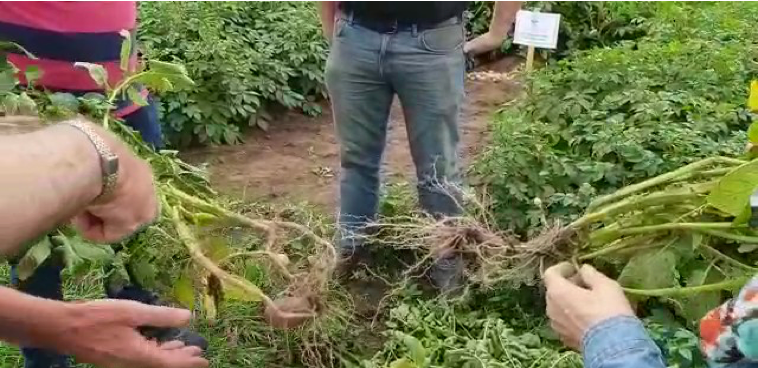
Where the rock dust was applied the potatoes developed a more extensive root system with lots of micro rootlets, see Figure 1 to see increased microorganism activity.
Figure 1: Root system
The figure shows there is many more micro rootlets on the right-hand side plant. This plant was from the trials that had the rock dust applied. This shows that rock dust had stimulated the plant to develop a much better root system. The wide range of trace elements in the rock dust improved the existing soil microorganisms to quickly multiply and process the nutrient availability in the soil quickly, e.g., better root system subsequently producing a higher yielding crop.
Earthworms
The trials showed an increased earthworm count when rock dust was applied shown in Figure 2 compared to soil where just fertilizer applied shown in Figure 3. This shows that Rock dust improves soil activity therefore, soil health.
Figure 2: Trial application of FYM + Rock dust
Figure 3: Trial plot application of Fertilizer
This figure shows that there were little to no earthworm activity in the plot where just fertilizer was applied.
The cultivations and planting for both plots were carried out at the same time and same procedures.
Soil samples from both plots have been forwarded to Newcastle University for tests to be conducted out to know the nutrient availability in both soils and the soil microorganism levels.
Wildflower Results
Where rock dust was applied it showed positive results to the wildflowers. These results could be seen by the naked eye as the crop with rock dust was denser and taller. See Figures 2 & 3.
The July rain heightened the rock dust activity as the silicates progressively dissolved by the rainwater and provided more nutrients available to the plants.
Figure 4: wildflowers with rock dust
Figure 5: wildflowers without rock dust
Conclusion
Overall, the potato trail results showed that Rock dust had a positive impact where it was applied. It increased the soil activity while also showing that there was the same yield was reached than if fertilizer was applied. It also improved plant health as the plant had a bigger root system in the soils with rock dust.
The wildflower results also showed a positive affect where rock dust was applied as it was seen to the naked eye that the plants were denser and taller in that area.
Further soil testing is being performed on the trial area to better understand the residual macro nutrients and trace elements from the rock dust and remaining in the soil for the next crop. In addition studies will be made to assess the earthworm population increase (hence soil health) over time due to the rock dust.